Alignment After a Lift or Long-Travel Kit: Which Specs to Use
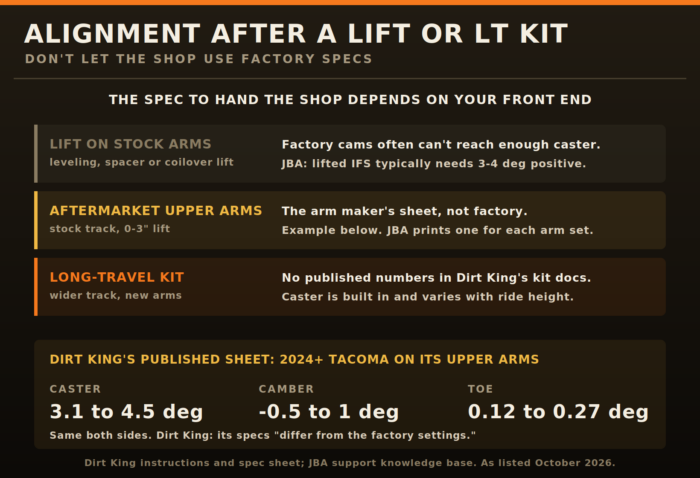
The short answer: don’t let the shop align a lifted or long-travel truck to factory specs. Dirt King’s sheet for the 2024+ Tacoma on its upper arms says its recommended specs “differ from the factory settings”: 3.1° to 4.5° caster, −0.5° to 1° camber and 0.12° to 0.27° toe per side. JBA says lifted vehicles “typically need a positive caster between 3 and 4 degrees.” Bring the arm or kit maker’s numbers to the shop, set ride height first, and recalibrate driver-assist systems afterwards.
Why factory specs stop working after a lift
JBA’s support page puts it plainly: a lift changes suspension geometry, and “the factory upper control arms were not designed for that new ride height.” Lifting an independent front end doesn’t add travel. It moves the suspension to a different starting point, which changes the upper arm angle, the ball joint angle, and the caster and camber ranges.
The usual result, per JBA, is a shop that says the truck is “as close as they can get it” while it still wanders, pulls or wears tires unevenly. One of the most common shortfalls is not enough positive caster. The truck follows grooves, feels nervous at highway speed and doesn’t return to center well. JBA’s warning about the alignment printout: “the green boxes on the screen are only part of the story.” A truck can show green and still have too little caster for its tire size.
Which numbers to hand the shop
That depends on what’s holding the front wheels:
- A lift on stock arms (leveling, spacer or coilover lift). The shop works within the factory cam range, and after a lift that range is often not enough. JBA’s signs that the stock arms are the limit: caster still low after alignment, camber that can’t be fully corrected, or cams the shop calls “maxed out.” JBA, which sells upper arms, says that’s when they’re usually the fix. It rates its arms for lifts of roughly 1 to 3.5″, and up to about 4″ in some applications.
- Aftermarket upper arms (stock track). Use the arm maker’s numbers. All three arm makers we checked build in extra caster. Dirt King’s instructions for its Colorado boxed arms say they have “increased castor built in to compensate for lifting the vehicle.” JBA prints a book for each arm set with a front-end alignment section. ICON says its 2005–2023 Tacoma arms have “built-in caster correction.”
- A long-travel kit (wider track, new upper and lower arms). Dirt King’s long-travel instructions we read give no alignment numbers. They say the suspension “has additional caster built into it” and that caster varies with ride height. Ask the kit maker for its target before the alignment appointment.
Dirt King’s published sheet
| Truck and parts | Caster | Camber | Toe |
|---|---|---|---|
| 2024+ (4th gen) Tacoma, Dirt King upper control arms | 3.1° to 4.5° | −0.5° to 1° | 0.12° to 0.27° |
Dirt King recommended alignment specs, as listed October 2026. The sheet gives the same numbers for the left and right front. Dirt King tells owners to print it and bring it to the shop “so the technician can use the correct Dirt King specs.” It’s the only numeric sheet we found in the Dirt King instructions we read. For any other arm or kit, ask the maker for its sheet.
Before and after the alignment
- Set ride height first. Caster on a long-travel kit varies with ride height, according to Dirt King, so finish coilover preload and let the truck settle before aligning. JBA also warns that a lift is often taller than advertised. A “2-inch level” can end up more than 2″ once spacers, spring rate and accessory weight are counted.
- Bring the maker’s sheet. A shop with only the factory specs will chase the wrong targets.
- Recalibrate driver-assist systems. Dirt King’s upper arm instructions for the Tacoma, Tundra, F-150 and Silverado all say that if the truck has Advanced Driver Assistance Systems (ADAS), it must be recalibrated after the alignment.
- Re-check clearance at full lock. Caster and camber changes can move the tire. If it now touches the upper arm, see tire rubbing the upper control arm.
Lifted truck alignment FAQ
How much caster should a lifted truck have?
JBA says lifted vehicles typically need 3 to 4 degrees of positive caster. Dirt King’s sheet for the 2024+ Tacoma on its arms is 3.1° to 4.5°. Use your arm or kit maker’s number where one exists.
Do I need an alignment after installing upper control arms?
Yes. Dirt King’s instructions tell owners to have the truck aligned by a certified or qualified shop after installing its arms, and to recalibrate ADAS if the truck has it.
Why won’t my lifted truck align?
On a lift with stock upper arms, the factory cams often run out of adjustment before caster or camber reach the right numbers. JBA’s other causes include a lift that’s taller than advertised and arms that don’t match the lift type.
Can I use factory alignment specs with a long-travel kit?
Dirt King says its long-travel suspension has extra caster built in and that caster depends on ride height, so don’t assume factory caster targets apply. Ask the kit maker for its numbers.
More suspension and steering guides
- Tire rubbing the upper control arm
- Wheel backspacing for long travel
- Prerunner steering and bump steer
- Long-travel suspension explained
- Dirt King prerunner suspension
- Toyota Tacoma prerunner build
Categorized in: Prerunner Builds