Prerunner Exhaust: Routing, Clearance and What Survives the Desert
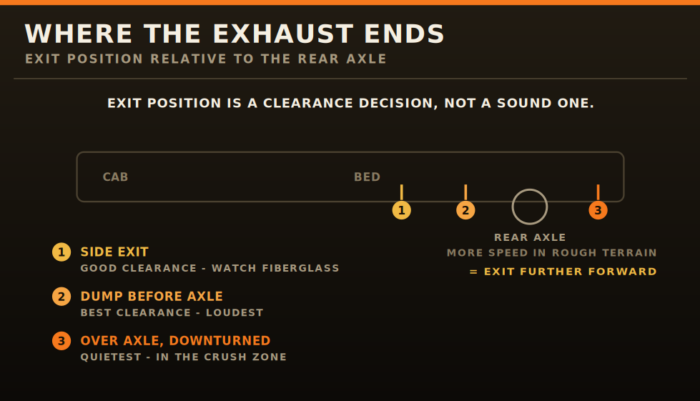
The short answer: on a prerunner, exhaust is a packaging and survival problem before it is a power problem. Almost every exhaust guide online is written about sound and horsepower on a street truck. On a desert truck the pipe is one of the lowest things under you, it competes for space with long-travel suspension, and the rear axle is moving a foot or more at speed. Route it wrong and you will tear it off in a whoop section.
Why a desert truck changes the rules
Three things make a prerunner different from the truck an off-the-shelf cat-back was designed for:
- The axle moves — a lot. With long travel front and rear, anything routed near the axle or hung behind it gets cycled hard every time you hit a whoop. Hangers that survive a highway do not survive that.
- Ground clearance is survival, not spec-sheet trivia. A tailpipe is often the lowest point behind the skid plate. When the rear bumper dips on a G-out, whatever hangs past the axle takes the hit first.
- Heat has nowhere to go. Desert running means low speed in high ambient temperatures with the pipe close to fuel lines, wiring and fiberglass. Routing and shielding matter more than they do on pavement.
Where the exhaust exits — the decision that matters most
Exit position is the single biggest call, and it is a clearance decision:
- Dump before the rear axle. The common desert answer. Nothing hangs behind the axle to get torn off when the back of the truck dips, and there is no pipe for a trailer or chase rig to worry about. Loudest option, and it puts exhaust nearer the fuel tank — shield accordingly.
- Side exit. Exits ahead of the rear tire, out the side. Good clearance, keeps the pipe out of the departure angle, popular on race and chase trucks. Watch placement relative to fiberglass bedsides — heat and glass do not mix.
- Over-axle, downturned tip. The quietest and most street-friendly, but you are accepting a pipe in the crush zone. Workable on a dual-purpose truck that still daily drives.
The general rule builders land on: the more time the truck spends at speed in rough terrain, the further forward the exhaust should end.
Muffler placement and tone
Where the muffler sits changes both durability and sound, and the two pull in opposite directions:
- Closer to the engine gets hot faster, so it clears condensation and tends to last longer — and gives a louder, higher-pitched tone.
- Further back gives a deeper tone and keeps heat away from the cab, but on a prerunner it also pushes the heaviest part of the system toward the area that takes the most abuse.
Conventional practice is to allow a reasonable straight run of pipe — commonly cited as around three feet — before the first bend after the muffler, and to run the headers into an H or X pipe under the transmission output to equalise flow and kill drone. Treat those as starting points from the fabrication community rather than hard rules; the right answer depends on your engine and how much cab noise you will tolerate on a long transit.
Hardware builders commonly reach for: a 3" system with an X-pipe and shorty mufflers for a V8 prerunner, or a SuperTrapp-style disc muffler, where you tune volume and backpressure by adding or removing discs — genuinely useful when the same truck has to pass a sound limit at one event and not at another. MagnaFlow, Flowmaster and SuperTrapp are the names that come up most.
What actually breaks
- Hangers. Factory rubber isolators are the usual first failure. Desert trucks get welded or heavy-duty mounts, and enough slack that engine movement is not pulling on the pipe.
- Crushed pipe. Anything below frame level will eventually find a rock. Tuck it up or accept it as a consumable.
- Heat damage to nearby parts. Fuel lines, wiring looms and fiberglass all sit near exhaust on a tightly packaged truck. Wrap, shield or reroute — do not hope.
- Cracked welds. Vibration plus a rigid mount cracks tube. Flex sections between the engine and the fixed part of the system are cheap insurance.
Bolt-on or custom?
Off-the-shelf off-road cat-backs exist for popular platforms and are a reasonable start on a mild build — they usually tuck the pipe higher and exit before or just after the axle. Once the truck has long travel, a bigger tire and a cut rear, the exhaust becomes fabrication like everything else: it has to be routed around what is actually on your truck. Any shop that builds desert trucks can bend and hang a system; our fab shop directory lists them by region.
Prerunner exhaust FAQ
Should a prerunner exhaust dump before the rear axle?
For a truck that sees real desert speed, usually yes. Nothing hangs behind the axle to be torn off when the rear end compresses or the bumper digs in. The tradeoffs are noise and heat near the fuel tank, so shield it properly.
Does exhaust actually add power on a prerunner build?
Some, but it is rarely the reason to do it. On this kind of truck the wins are packaging, clearance and durability. If you are chasing performance, suspension and tyres buy far more capability per dollar — see what a prerunner build costs.
Will a side-exit exhaust melt fiberglass bedsides?
It can if the exit is aimed at them or sits too close. Keep the tip clear of the panel, angle it away from bodywork, and use shielding where the pipe runs near glass.
Do I need a catalytic converter on a prerunner?
If the truck is registered and driven on the road, yes — emissions equipment is part of what keeps it street legal, and California enforces this seriously. See are prerunners street legal before planning a cat delete.
More prerunner build guides
- Long-travel suspension explained
- Fiberglass fenders & bedsides
- Best truck to build into a prerunner
- Find a fab shop near you
Categorized in: Prerunner Builds